Application Solution for Production Line Workstation Management Based on RFID Technology
Abstract
Driven by the wave of Industry 4.0 and smart manufacturing, the manufacturing industry is undergoing a profound digital transformation. The efficiency, transparency, and flexibility of production lines have become key indicators for measuring a company's core competitiveness. However, traditional production line management methods, especially workstation management relying on manual recording and barcode scanning, have increasingly become bottlenecks restricting development, leading to pain points such as data delays, frequent errors, and difficult traceability that users complain about.
This solution aims to deeply analyze the application solution for production line workstation management based on RFID (Radio Frequency Identification) technology, systematically explaining how it precisely solves the core pain points of manufacturing users. The solution will first identify and analyze the common difficulties of traditional workstation management, then introduce the composition and working principle of the RFID solution, and how it brings significant operational benefits to enterprises through mechanisms such as automated data collection, real-time process monitoring, and precise material error-proofing.
Chapter 1: Analysis of Core Pain Points in Traditional Production Line Workstation Management
In daily production operations, manufacturing enterprises have long faced a series of pain points arising from traditional management methods, especially in workstation management. These pain points not only reduce production efficiency but also directly affect product quality and the company's market response speed.
1. Inefficient data collection and frequent errors: Traditional models rely heavily on manual entry or barcode scanning. This method not only consumes a lot of manpower but is also prone to errors. For example, workers under high-intensity operations may forget to scan, scan the wrong barcode, or manually enter incorrect data, leading to distorted production data.
2. Lack of real-time transparent process monitoring: Management cannot grasp the specific location and status of each work order and each product on the production line in real time. Information is usually lagging, presented in the form of daily or shift reports. This "black box" state leads to delayed problem detection. When production bottlenecks, material shortages, or equipment failures occur, managers cannot intervene in time, causing production stagnation and resource waste.
3. Huge challenges in material mismatch and quality traceability: In complex assembly lines, ensuring that each workstation uses the correct materials is a difficult task. Manual verification is inefficient and unreliable. Once wrong materials or missing parts occur, not only defective products are produced, but it may even lead to quality issues for the entire batch. When quality problems occur, due to the lack of precise process data at the workstation, time, and batch level, reverse traceability becomes extremely difficult, responsibilities are hard to define, and improvement measures cannot be implemented.
4. Work-in-progress (WIP) accumulation and production rhythm imbalance: Due to information opacity, the production rhythm between workstations is difficult to coordinate. Upstream workstations may overproduce, causing WIP to accumulate in front of downstream workstations; downstream workstations may also be idle waiting for materials or semi-finished products. This imbalance severely affects the overall output efficiency and capital turnover of the production line.
5. Constraints on flexible production and personalized customization: As market demand becomes increasingly diverse, multi-variety, small-batch flexible production has become a trend. Traditional management methods struggle to cope with frequent production line changeovers and complex production instructions. When switching between different products, workers are prone to confusing process documents, using wrong tools or materials, severely limiting the company's flexible manufacturing capabilities.
Chapter 2: Architecture and Core Advantages of the RFID Solution
RFID technology provides an ideal tool for solving the above pain points through contactless automatic identification. A typical RFID-based production line workstation management system solution architecture usually includes the following layers:
2.1 System Technical Architecture and Core Hardware
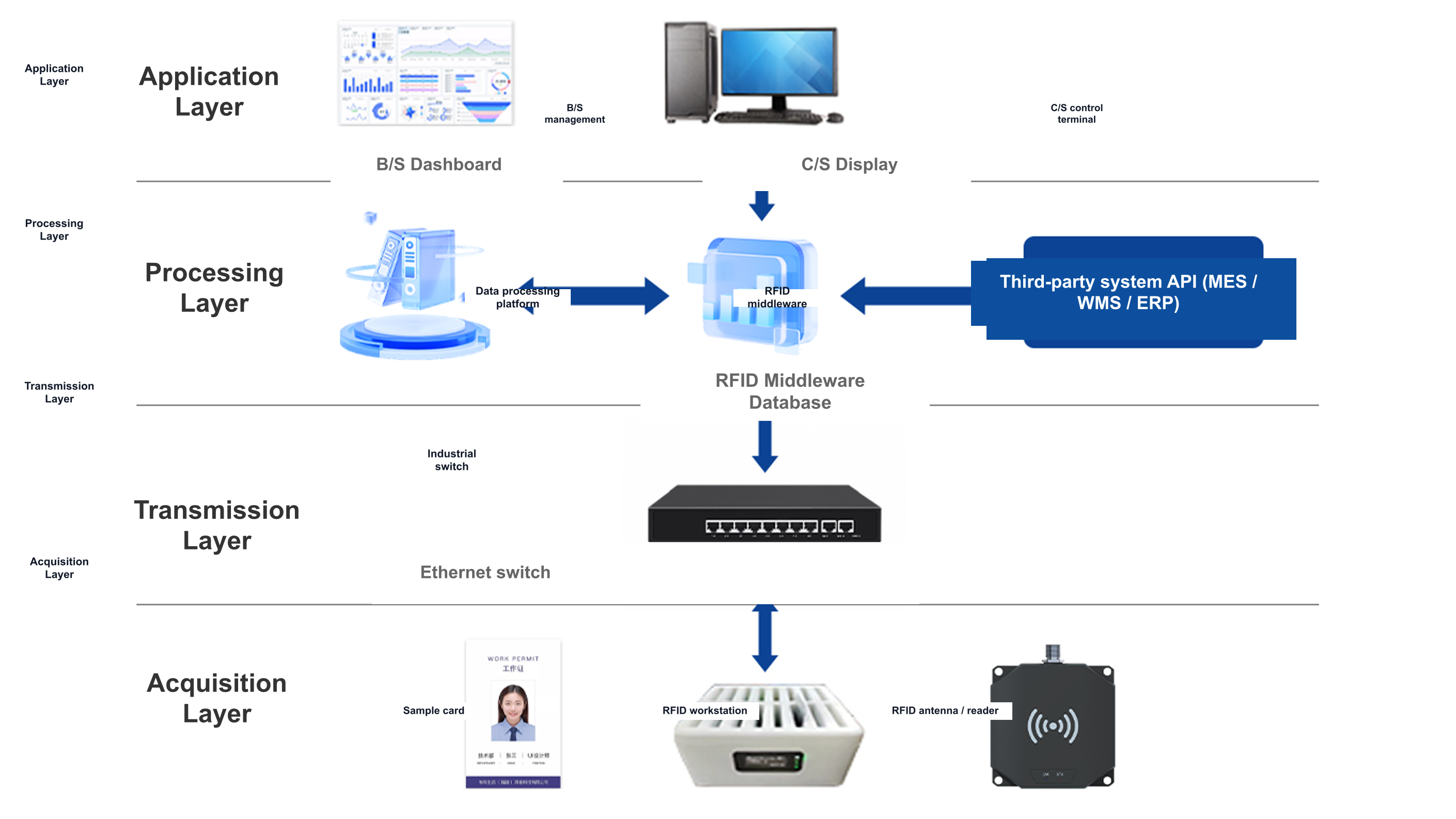
Hardware Components (Perception Layer): This is the foundation of data collection.
RFID Electronic Tags (Tag): Attached to WIP, pallets, material bins, or even tools, serving as the unique electronic ID of the production object. The tag stores key information such as product model, batch, and process route.
RFID Reader/Antenna (Reader/Antenna): Installed at the entrance, exit, or operation area of each key workstation. They automatically read tag information entering their sensing range or write new status information (e.g., "process completed", "quality inspection passed") to the tag.
Handheld Reader (Handheld Reader): Used for mobile operations, inventory, or exception handling, providing flexibility to the system.
Software and Interfaces (Network Layer and Application Layer): This is the "brain" of the system.
RFID Middleware (Middleware): Responsible for managing and controlling readers, filtering, cleaning, and processing the massive raw tag data collected, converting it into business-meaningful event information (e.g., "Material A has arrived at Workstation B").
Application Software Platform: Includes functional modules such as workstation management, WIP tracking, production dashboard, data analysis, and report generation. It provides users with a visual interface to display the production line status in real time.
System Interfaces: The system must be able to seamlessly integrate with the enterprise's existing Manufacturing Execution System (MES), Enterprise Resource Planning (ERP) system, etc. Through interfaces, data collected by the RFID system can be updated in real time to the upper management system, enabling automatic issuance of production instructions and automatic reporting of production performance.
2.2 How RFID Precisely Solves User Pain Points
Through the above architecture, RFID technology digitizes the physical production process, thereby precisely solving the pain points of traditional management.
Achieving automated, touchless data collection to improve data accuracy: When WIP with RFID tags flows through a workstation, the reader automatically and batch-collects data without manual intervention. This not only frees workers from tedious scanning tasks but also fundamentally eliminates human errors such as missed scans or wrong scans, ensuring real-time and accuracy of source data up to 99%.
Building a real-time transparent "digital twin" production line: The system can track the location, status, and dwell time of each WIP in real time and display it visually on electronic dashboards or management interfaces. Managers can see the overall production line like a "battle map," clearly identify bottleneck workstations, abnormal dwells, and other issues, and make quick scheduling decisions.
Strengthening process control to achieve intelligent error-proofing and quality traceability:
Intelligent Error-Proofing: The system can achieve "three-point binding" — work order, material, and workstation. When material arrives at a workstation, the system automatically verifies whether its RFID tag information matches the current work order requirements. If inconsistent, the system immediately alarms to prevent wrong materials from being used. Similarly, the system ensures products flow according to the preset process route, preventing process errors such as skipping stations or wrong stations.
Precise Traceability: The processing time, operator, and material batch used for each product at each workstation are accurately recorded and bound to the product's unique ID. Once a quality problem occurs, simply scanning the product tag instantly retrieves its complete "production history," enabling forward traceability from finished product to raw material and reverse traceability from raw material to finished product warehouse.
Optimizing production rhythm and reducing WIP accumulation: By monitoring the WIP quantity and processing rhythm of each workstation in real time, the system can automatically calculate the production line balance rate and provide data support for production scheduling. Managers can adjust the production rhythm of each workstation based on real-time data to achieve pull production, thereby minimizing WIP inventory and improving production line flow efficiency.
Chapter 3: Return on Investment (ROI) Analysis
• Tangible Benefits (Quantifiable):
Labor Cost Savings: Reduce manpower required for data entry and material verification.
Production Efficiency Improvement: Shorten production cycle time, improve equipment utilization (OEE).
Inventory Cost Reduction: Reduce WIP accumulation, accelerate inventory turnover.
Quality Cost Reduction: Reduce scrap and rework rates caused by wrong materials or assembly errors, minimize recall losses.
• Intangible Benefits (Difficult to quantify directly but highly valuable):
Data-Driven Decision-Making Capability: Provide accurate, real-time data to support management in scientific decision-making and continuous improvement.
Customer Satisfaction Improvement: Improve on-time delivery rate, enhance product quality traceability.
Enterprise Competitiveness Enhancement: Improve production flexibility and agility to better respond to market changes.