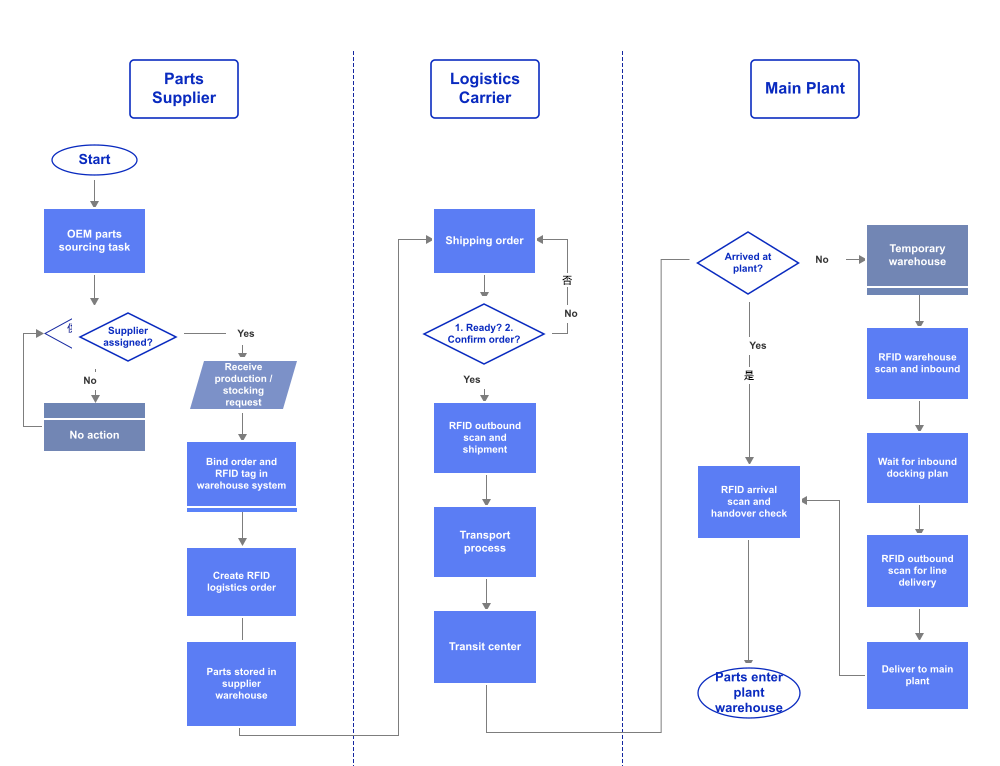
RFID-Based Digital Warehouse Logistics Solution for Automotive Plants
System Overview
When the warehousing industry exists as a business format, logistics is a necessary means for it to achieve value-added services; in the logistics industry, warehousing is an indispensable important node. The development of modern logistics requires modern warehouse management as support, and informatization and advanced technology guided by informatization have become effective ways for the warehousing industry to move towards modernization.
Advanced infrastructure and automation functions are the foundation for achieving warehouse modernization, such as high-platform three-dimensional warehouses, shelves that can store different types of goods, effective operating platforms, forklifts capable of RFID scanning, automated cargo conveying devices, temperature control devices, sprinkler devices, monitoring devices, etc.; the construction of information network platforms is an effective means to achieve warehouse modernization. By comprehensively applying modern scientific management methods and modern information technology means, it reasonably and effectively organizes, commands, schedules, and supervises various activities such as material inbound, outbound, storage, loading and unloading, handling, measurement, custody, finance, and security, achieving high quality and high efficiency of operations and obtaining better economic benefits.
In Western developed countries, the degree of modernization of the warehousing industry has created conditions for enterprises to obtain high profits. In China, some large logistics enterprises are also practicing and enjoying the convenience brought by advanced informatization. Digital information systems provide enterprises with scientific and standardized business management, real-time production monitoring and scheduling, comprehensive and timely statistical analysis, multi-level query and reconciliation functions, multi-channel and convenient query methods including online queries, and management functions for new value-added services, meeting the requirements of warehouse management and business decision-making, becoming a tool for enterprise marketing and development. The warehouse information management system integrates the logistics organization system, reconstructs the warehouse management model, effectively reduces operating costs, achieves significant economic benefits, and also wins the respect and trust of customers.
On the basis of the existing warehouse environment, the construction of information networks and the application of information technology will further improve the level of warehouse value-added services, effectively connect various operation links, and make comprehensive logistics business the main direction of warehousing industry development, extending the functions of the warehousing industry upstream and downstream, thereby obtaining more value-added income. The optimization and reform of business processes will greatly improve the efficiency of the warehousing industry and expand the scope of services.
Compared with barcode labels, RFID has multiple advantages such as long recognition distance, fast recognition speed, self-information storage capability, and strong environmental adaptability, making it the best choice for warehouse management in large enterprises. With a good warehouse logistics management system, RFID can achieve dynamic warehouse logistics management, allowing real-time query and management of warehouse logistics information in the system, and realizing reasonable allocation of resources.
The overall process of warehouse logistics involves multiple inventory checks, outbound and inbound counting and verification of assets in logistics transportation. Manual counting has many problems such as long time consumption, high error rate, and low transportation efficiency. The more nodes the warehouse logistics process passes through, the more repeated inventory checks are required, and the greater the probability of errors. Through the RFID warehouse logistics management system, work efficiency is greatly improved, and labor costs and error rates are reduced.
System Framework