Application Solution for Full-Process Quality Traceability in Molding Production Based on RFID Technology
Abstract
This solution aims to deeply explore the application of Radio Frequency Identification (RFID) technology in quality management and full-process traceability in the molding production (especially injection molding) field. The molding manufacturing industry generally faces core pain points such as opaque production processes, difficulty in tracing quality issues, low data collection efficiency, and high manual management costs. These issues severely constrain production efficiency, product yield, and market competitiveness. As an advanced automatic identification technology, RFID, with its advantages of non-contact, long-range, batch reading, and tolerance to harsh environments, provides strong technical support to address the above pain points. This solution will elaborate from user pain points, detailing how RFID technology runs through the entire process from raw materials, mold management, production processing, quality inspection, warehousing and logistics to final delivery, constructing a closed-loop, transparent, and efficient quality traceability system. It will also analyze the technical architecture and response strategies of the solution, and demonstrate the actual value it brings to enterprises through ROI assessment.
1. Introduction: Dilemmas in Molding Production Quality Management and the Need for Technological Change
Molding production, especially injection molding, is the foundation of modern manufacturing. Products are widely used in key industries such as automotive, electronics, medical, and home appliances, and their quality directly affects the performance and safety of end products. However, traditional production management models are facing unprecedented challenges.
1.1 Core User Pain Point Analysis
Through communication with many molding production enterprises and industry observations, we have identified the following common user pain points:
Difficulty in tracing quality issues, slow response: When product quality defects occur, traditional reliance on paper documents or isolated electronic spreadsheets for traceability is time-consuming and labor-intensive, often failing to quickly and accurately locate the specific link where the problem occurred.
Opaque production process, severe information silos: Information gaps between processes on the production line are common, and managers cannot grasp the status, location, and flow of work-in-progress (WIP) in real time. Data of key production elements such as materials, molds, equipment, and products are recorded separately, leading to difficulties in production scheduling and bottlenecks in efficiency.
Data collection relies on manual labor, low efficiency and accuracy: Many factories still rely on barcode scanning or manual entry for data collection. Barcodes are easily damaged, require close-range alignment for scanning, and cannot be read in batches, resulting in low data collection efficiency and high susceptibility to human errors.
Chaotic mold management, underutilized lifecycle value: Molds, as core assets in molding production, are often managed roughly. Molds are numerous and valuable, but information such as usage count, maintenance records, current status, and storage location is often incomplete or not updated in a timely manner. This not only wastes time in finding molds but also prevents preventive maintenance and life prediction, increasing production downtime risk and asset waste.
Limitations of batch-level traceability: Traditional traceability often stays at the batch level, associating the entire batch of products with the same set of production data. This means that if a single defective product appears in a batch, the entire batch may be isolated or recalled, causing huge waste. Achieving single-piece-level precise traceability is an urgent need to improve the granularity of quality management.
2. RFID Solution: Building a Full-Process Closed-Loop Quality Traceability System
The core idea of the RFID-based molding production quality traceability solution is to assign a unique electronic 'ID card'—an RFID tag—to each key production element (such as material bins, molds, WIP, and finished products). By deploying RFID read/write devices at key nodes of the production process, automatic, real-time, and batch collection of information on these elements is achieved. The data is deeply integrated with the enterprise's Manufacturing Execution System (MES) or Enterprise Resource Planning (ERP) system, thereby opening up information flow and realizing full-process transparent management from 'raw materials' to 'finished products'.
2.1 Solution Architecture and Process Design
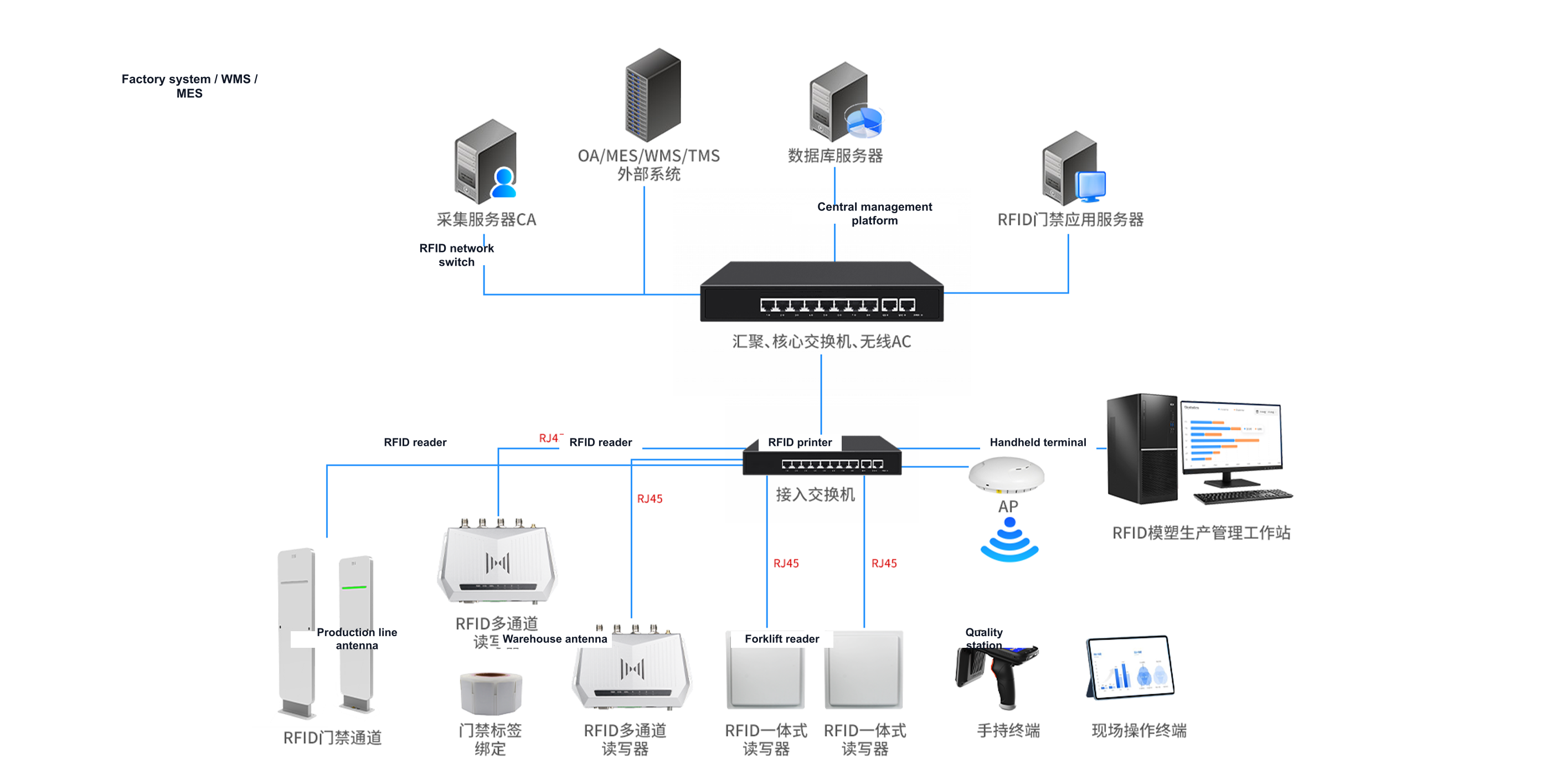
A complete RFID quality traceability system typically includes the following layers and process steps [43][44]:
Physical Layer: Includes hardware devices such as RFID electronic tags, readers, and antennas.
Data Collection Layer: Readers deployed at various nodes on the production line automatically identify and read tag information through antennas.
Data Processing Layer: RFID middleware processes raw data from readers, performing filtering, cleaning, and aggregation, and distributes it to upper-layer application systems based on business logic.
Application Layer: Enterprise information systems such as MES/ERP receive, store, and analyze RFID data, providing a data foundation for production management, quality traceability, and decision support.
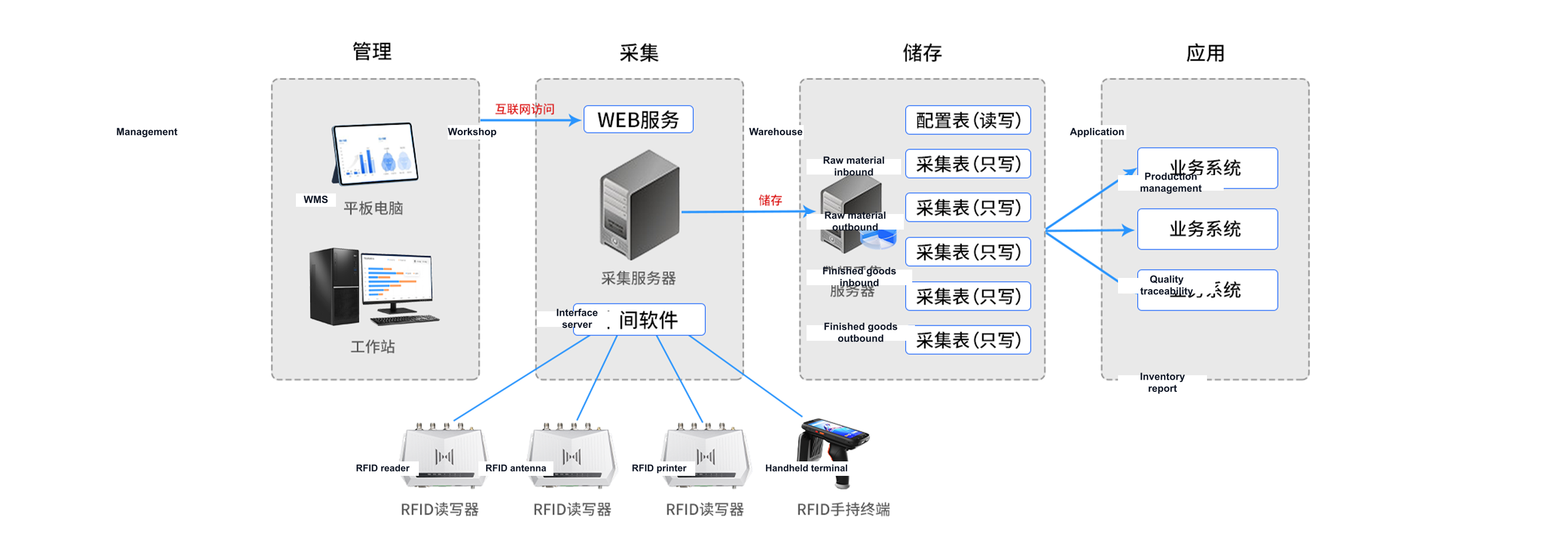
Detailed Full-Process Traceability Application Scenarios:
1. Raw Material Inbound and Requisition Management:
• Pain Point Solved: Resolves issues of batch information confusion and difficulty in FIFO management for raw materials.
• Implementation: Attach RFID tags to raw material bins or pallets, recording information such as supplier, batch number, inbound time, and inspection status. Install RFID readers at warehouse entrances and storage locations for fast and accurate inbound/outbound inventory. When the production line picks materials, the system automatically records the bin ID and binds it to the production order.
2. Full Lifecycle Mold Management:
• Pain Point Solved: Addresses difficulties in finding molds, unknown status, untimely maintenance, and inability to predict lifespan.
• Implementation: Install high-temperature resistant, anti-metal special RFID tags on each mold, storing static information such as unique mold ID, model, design life, and cumulative usage count. Deploy readers in the mold warehouse, maintenance room, and near injection molding machines to track mold location in real time. Each time a mold is used for production, the system automatically reads the mold ID and records usage count and production parameters. When the usage count approaches the maintenance threshold or lifespan threshold, the system automatically issues an early warning to guide preventive maintenance, avoiding production interruptions and quality issues caused by mold failure.
3. Injection Molding Process Monitoring and Data Binding:
• Pain Point Solved: Resolves the problem of opaque production processes and inability to precisely associate products with production elements (man, machine, material, method, environment).
• Implementation:
▪ Single-Piece Traceability Starting Point: After injection molding, assign a unique RFID tag to each product or the tray carrying the product.
▪ Automatic Data Association: The RFID reader near the injection molding machine automatically reads the current mold tag ID, operator badge ID, raw material bin ID, and obtains key process parameters (such as temperature, pressure, speed) from the equipment PLC or MES system. All this information (5M1E) is bound in real time to the product/tray's RFID tag ID and written into the database.
▪ Process Node Tracking: At subsequent process nodes such as quality inspection, trimming, assembly, and painting, deploy RFID read/write channel gates or workstation readers to automatically record product arrival and departure times, operator information, and processing results (e.g., OK/NG), forming a complete, single-piece-level product 'growth history'.
4. Quality Inspection and Defective Product Management:
• Pain Point Solved: Addresses issues of lagging quality inspection information recording, unknown flow of defective products, and difficulty in tracking rework processes.
• Implementation: Quality inspectors use handheld RFID devices or deploy readers at inspection stations to scan product tags and enter inspection results (OK/NG), defect types, etc., into the system. For NG items, the system automatically updates their status and directs them to the repair or scrap process via RFID sorting devices on the production line, preventing defective products from flowing to the next process.
5. Finished Product Inbound, Outbound, and After-Sales Traceability:
• Pain Point Solved: Resolves issues of low warehouse management efficiency, error-prone shipping, and overly broad recall scope.
• Implementation: Attach RFID tags to finished product packaging boxes. During inbound, use RFID channel gates for batch and fast inbound registration. During outbound, the system checks the box tags against order information for automatic error-proofing. When a quality complaint arises from the market, simply scan the product or packaging tag to retrieve its full production data from raw materials to outbound within seconds, quickly locating the root cause and precisely identifying the affected product range for targeted recall.
3. Return on Investment (ROI) Assessment
Increased Production Efficiency: Automated data collection replaces manual scanning and entry, significantly reducing time for material handover, WIP inventory, and inbound/outbound operations. For example, RFID technology can reduce asset inventory time by over 90%. Quick location of molds and materials reduces production preparation and waiting time, directly improving Overall Equipment Effectiveness (OEE).
Reduced Quality Costs:
Decreased Defect Rate: Real-time process monitoring and data association help detect production anomalies promptly, preventing batch quality issues. Cases show that through RFID systems, defect rates have dropped from 3.2% to 0.8%, and even from 0.8% to 0.3% in some cases.
Reduced Recall Costs: Single-piece precise traceability allows enterprises to avoid recalling entire batches when quality issues occur, handling only the few problematic products, greatly narrowing the recall scope and economic loss.
Reduced Labor Costs and Errors: Automated identification reduces reliance on production line data entry and verification personnel, lowering labor costs. Machine recognition accuracy is far higher than manual, avoiding issues like material misallocation and process errors due to human mistakes, reducing related rework and waste.
Optimized Inventory Management: Real-time, accurate inventory data visibility enables enterprises to lower safety stock levels, increase inventory turnover, and reduce capital occupation.