RFID Technology Revolutionizes Pallet Management in Health Product Factory, Enhancing Warehouse Efficiency and Accuracy
Project Background
Currently, the entire warehouse has about 50,000 pallets in circulation. Pallet codes currently use 1D barcode stickers for reading and identification. Since barcodes are printed products, they are prone to scratches, deformation, aging, and falling off, leading to a very high failure rate in inbound/outbound barcode reading, causing management difficulties. During raw material receiving, the WMS system prints self-adhesive barcode labels, and manual barcode scanning is used to associate the raw material bag label code with the supplier's temporary pallet label code. Barcode scanning operations for association, inbound/outbound, and inventory are inefficient, wasting labor and material resources, and incurring high management and maintenance costs.
Objective
Using RFID chips as carriers, record the real-time circulation process of pallets through contactless scanning, track the circulation information of raw materials and finished products, ultimately achieve precise control over finished product inventory, realize fast inbound/outbound, real-time inventory, quick product search, and anti-mis-dispatch functions, meet real-time online data transmission, and seamlessly integrate with the WMS system, greatly improving work efficiency.
Requirements
By retrofitting traditional pallets, achieve electronic pallet information and automated collection during circulation, thereby realizing automatic pallet stacking, contactless collection at each collection point, and interaction with the warehouse WCS and WMS systems to seamlessly integrate with the original barcode system.
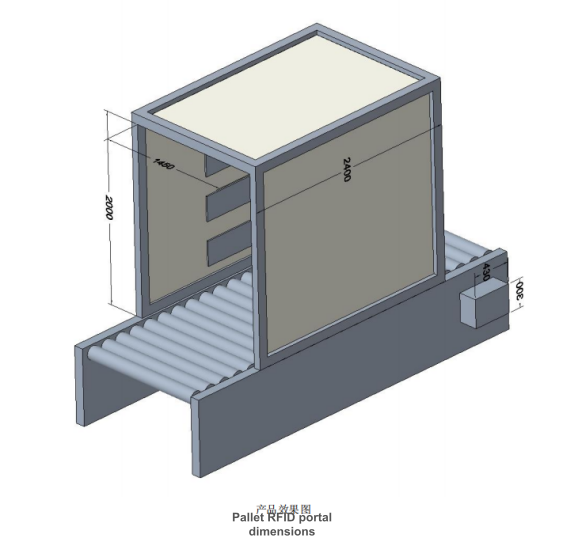
Implementation Steps
Pallet retrofitting: Attach RFID pallet tags to pallets, with barcodes laser-engraved on the tag surface to ensure compatibility with the original system.
Reader upgrade: Replace current barcode readers with RFID industrial readers to collect data at pallet circulation nodes.
Gantry installation: Install gantries on existing production lines with appropriate shielding to enable automatic pallet stacking and binding within the gantry, replacing manual barcode scanning for binding.
PDA for inbound/outbound: Add RFID PDA devices for batch collection and verification during inbound/outbound.
Forklift upgrade: Retrofit forklifts with RFID collection devices, allowing forklift drivers to move goods without getting off to scan.
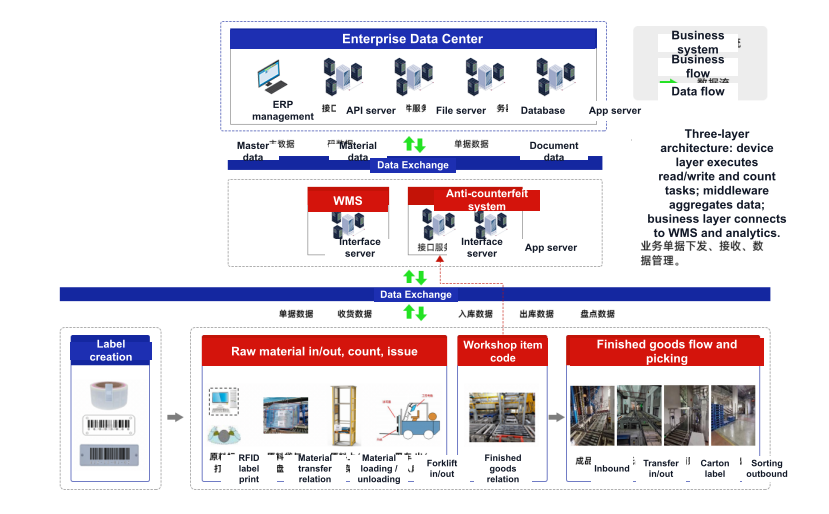
Benefits
1. Reduced labor intensity for workers and significantly improved work efficiency.
2. Using RFID pallet tags greatly reduces the occurrence of barcode tags being unreadable due to scratches or dirt.
3. RFID automatic contactless multi-tag collection can obtain data when the outer box is at the bow, greatly facilitating on-site application.
Conclusion
Modern manufacturing enterprises face immense competitive pressure and must reduce production, operation, and management costs through technological upgrades to maintain an advantage in industry competition. The inherent efficiency-enhancing properties of RFID technology make its application increasingly popular in manufacturing enterprises, with costs and effectiveness continuously improving.